 Welcome to China in Middle East Bridging the Gap Between China and the Middle East

Related Articles
From Oil Wells to Solar Panels
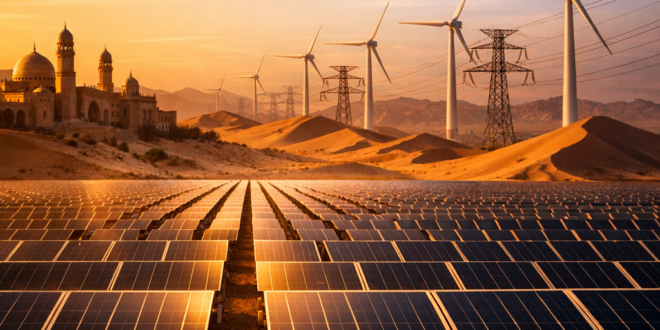
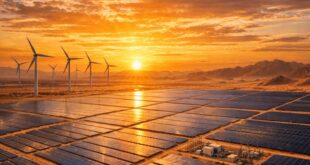
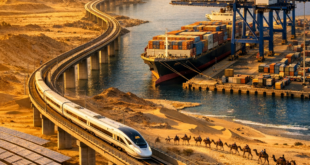
For half a century, the China-Middle East relationship was built on a simple transaction: crude oil flowed east, and manufactured goods flowed west. But 2026 is proving to be the year that equation fundamentally changed. The energy partnership between China and Gulf states is experiencing a dramatic green transformation—one that could reshape global power dynamics for decades to come.
The numbers tell a compelling story. China-Arab trade reached $407.4 billion in 2024, establishing China as the Arab world’s largest trading partner. Yet the most significant shift isn’t in the volume—it’s in the composition. Electric vehicles, lithium-ion batteries, and solar cells have become China’s “New Three” exports, and Gulf states are among the most eager customers.
The Saudi Solar Revolution
Saudi Arabia, long synonymous with black gold, is now aggressively pursuing green energy dominance. In August 2025, ACWA Power—Saudi Arabia’s leading renewable energy developer—announced that its 2.7 GW solar portfolio had officially entered commercial operation. This massive undertaking, worth approximately $3.3 billion, spans three solar power plants: Al Kahfah, Ar Rass 2, and SAAD 2.
What makes this remarkable isn’t just the scale—it’s the partnership. Chinese firms are deeply embedded in these projects. In late 2025, a Chinese energy consortium secured $2.745 billion in EPC contracts for Saudi Arabia’s renewable energy projects, working alongside ACWA Power, Saudi Arabia’s Public Investment Fund, and Saudi Aramco Power Company.
Why This Matters for Energy Security
The strategic implications extend far beyond economics. Recent tensions in the Strait of Hormuz have reminded Asia’s economies that energy security is less a policy abstract than an everyday reality. When shipping lanes face disruption, factories slow, prices spike, and economies shudder.
For China and Gulf states, the renewable energy transition offers something priceless: energy interdependence that doesn’t require tankers. Solar panels, battery storage, and electric vehicle infrastructure create a different kind of bond—one based on technology transfer, manufacturing partnerships, and long-term infrastructure co-development rather than volatile commodity markets.
Key developments accelerating this shift include:
- Solar manufacturing localization: Chinese firms are increasingly building factories in the Middle East rather than simply exporting finished panels
- Battery storage integration: Large-scale battery projects are being paired with solar installations to ensure grid stability
- Green hydrogen pilots: Both China and Gulf states are investing heavily in hydrogen as a future export commodity
- EV infrastructure: Chinese electric vehicle brands are establishing regional headquarters and charging networks across the Gulf
The New Energy Map
The International Energy Agency estimates global spending on electricity generation reached $1.5 trillion last year—some 50% greater than investment in oil, natural gas, and coal supply combined. This represents a historic power shift in global energy, and China-Gulf cooperation is at its center.
Gulf states have powerful incentives to accelerate this transition. Saudi Arabia, the UAE, and others are actively diversifying their economies beyond hydrocarbons, seeking to attract high-tech manufacturing and position themselves for a future where oil no longer underpins national development.
China, meanwhile, dominates the supply chains for solar panels, batteries, EVs, and grid technologies. The partnership is synergistic: Gulf states provide capital, land, and ambition; China provides technology, manufacturing expertise, and scale.
Looking Ahead
Energy analysts increasingly speak of a more ambitious China-Gulf energy deal—one that maintains stable oil trade while gradually shifting the cooperation focus to renewables, storage, electric vehicles, industrial localization, and green finance.
What emerges may be the world’s most significant clean energy partnership, connecting the manufacturing powerhouse of Asia with the capital-rich, sun-drenched deserts of the Middle East. For a relationship built on oil, the future looks surprisingly bright—and surprisingly green.
Sources: Middle East Council “The China-Gulf Green Rush” (2026); CGTN “China’s increasingly important role in Middle East energy transition” (2026); China Strategy “How China-Gulf ties can turn energy vulnerability into sustainability” (May 2026); Saudi Gulf Projects (November 2025); SolarBe Global (August 2025).