


 CNINME.COM China-Middle East trade intelligence, sourcing, market entry and business culture.

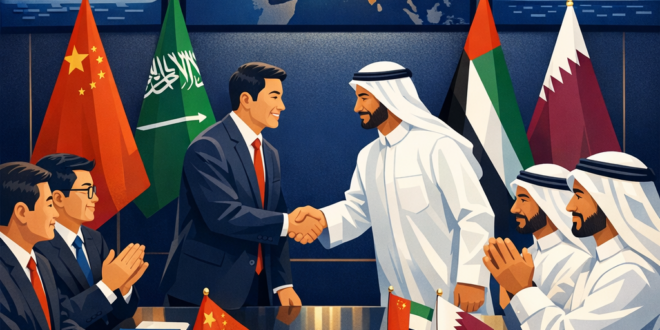
China-GCC Free Trade Agreement: Two Decades in the Making, 2026 Could Be the Breakthrough Year
Introduction
For over twenty years, negotiations between China and the Gulf Cooperation Council (GCC) have oscillated between promise and paralysis. But as 2026 draws to a close, the stars may finally be aligning. With the second China-Arab States Summit and the second China-GCC Summit both scheduled to take place in China, momentum is building toward what could be the most significant trade agreement in the region’s modern history.
The stakes are enormous. China is already the largest trading partner for Saudi Arabia and the UAE, with bilateral trade volumes reaching unprecedented levels. A formal free trade agreement would not only cement these economic bonds but also reshape the geopolitical landscape of the entire Middle East.
The Current State of China-GCC Trade
The numbers tell a compelling story of deepening economic integration:
- China-UAE non-oil trade reached AED 180.7 billion (approximately $49.2 billion) in the first half of 2026, maintaining China’s position as the UAE’s largest trading partner
- Saudi-China trade volume surpassed $49 billion, with China capturing 28.3% of Saudi Arabia’s total import market — more than three times the share of the United States (8.2%)
- Saudi merchandise exports to China constituted 56.5% of total trade, valued at SAR 103.9 billion this year
These figures underscore a fundamental shift in Gulf economic strategy. While hydrocarbons remain the backbone of the relationship, both sides are aggressively diversifying into technology, infrastructure, renewable energy, and advanced manufacturing.
Why 2026 Is Different
Several converging factors are creating unprecedented urgency to finalize the agreement:
Diplomatic Momentum: China’s special envoy Zhai Jun’s tour of Iran, Oman, and Saudi Arabia in November signals Beijing’s commitment to regional stability — a prerequisite for sustained trade growth. President Xi Jinping has repeatedly emphasized that the Middle East “should not become a battleground for great-power rivalry,” positioning China as a neutral economic partner.
Summit Pressure: With both the China-Arab States Summit and China-GCC Summit taking place in China in 2026, failure to announce substantive progress would be a diplomatic embarrassment for all parties involved.
Economic Necessity: The ongoing Strait of Hormuz tensions have exposed vulnerabilities in global energy supply chains. A formal trade framework would provide institutional stability that informal arrangements cannot guarantee.
Sector-Specific Protections: Recent negotiations have reportedly made progress on protecting sensitive sectors — a key sticking point that has derailed previous rounds. If these elements appear in official readouts, the agreement will have entered a fundamentally different phase.
What the Agreement Could Include
While final terms remain confidential, analysts expect the agreement to cover:
- Tariff elimination on 90%+ of goods traded between China and GCC states
- Investment protection mechanisms for Chinese infrastructure projects in the Gulf
- Digital trade provisions facilitating e-commerce and fintech cooperation
- Energy partnerships extending beyond oil to include renewables and nuclear
- Services liberalization in finance, logistics, and tourism
The UAE-China Chamber of Commerce has noted that “conditions are deemed highly favorable” for finalization, with both sides “striving to finalize the agreement at the earliest opportunity.”
Challenges Remaining
Despite the optimism, significant hurdles persist. The Asia Cable analysis warns that “if calls remain one-sided and formulaic, meaningful progress is not likely.” Key challenges include:
- Geopolitical balancing between China’s relationship with Iran and GCC security concerns
- Domestic industry protection in both Chinese and Gulf manufacturing sectors
- Regulatory harmonization across six diverse GCC economies
- US-China tensions potentially complicating Gulf states’ technology partnerships
The Bigger Picture
A China-GCC free trade agreement would represent more than just economic integration — it would signal a fundamental reordering of Middle East geopolitics. For decades, the region’s economic architecture was built around Western partnerships. A formalized China-GCC framework would institutionalize Beijing’s role as the region’s primary economic partner.
The Observatory of Economic Complexity notes that Saudi imports from China increased 20.51% year-on-year in early 2026, even as overall imports declined. This resilience suggests that economic gravity, not just diplomacy, is driving the relationship forward.
Conclusion
Whether 2026 finally delivers the China-GCC free trade agreement remains to be seen. But the convergence of diplomatic momentum, economic necessity, and summit deadlines has created conditions unlike any previous negotiation round. For businesses operating between China and the Gulf, the message is clear: prepare for a new era of institutionalized trade relations.
The twenty-year wait may finally be over.
Sources:
- UAE-China Chamber of Commerce: “China-GCC Free Trade Agreement: Breaking the Two-Decade Impasse in 2026”
- The Asia Cable: “Where Is the China-GCC Free Trade Agreement?”
- Economy Middle East: “China, UAE drive Saudi trade volume to second yearly high”
- Lloyds Bank Trade Portal: UAE Foreign Trade Figures H1 2026
- Al-Monitor/Reuters: “China’s Xi says Middle East should not become battleground for great power rivalry”
- CGTN: “Are China, GCC closer to free trade deal after Wang Yi’s visit?”
