 Welcome to China in Middle East Bridging the Gap Between China and the Middle East

Related Articles



The travel landscape between China and the Middle East has undergone a dramatic transformation in 2026. What was once a route requiring weeks of visa paperwork is now a streamlined corridor of mutual visa-free access, direct flights, and record-breaking tourism numbers. For travelers and businesses alike, this represents one of the most significant shifts in global mobility since the pandemic.
The Visa-Free Revolution
China has extended its unilateral visa-free policy through December 31, 2026, covering all six Gulf Cooperation Council (GCC) nations. Travelers from the UAE, Saudi Arabia, Qatar, Kuwait, Bahrain, and Oman can now enter China for up to 30 days without a visa. The impact was immediate and staggering.
- Flight searches from GCC nations to China surged by 90% on the first day of the policy rollout
- Saudi Arabia topped the list of nations with the highest search volume
- The trial policy could become permanent if inbound tourism continues to grow
Soaring Flight Connections
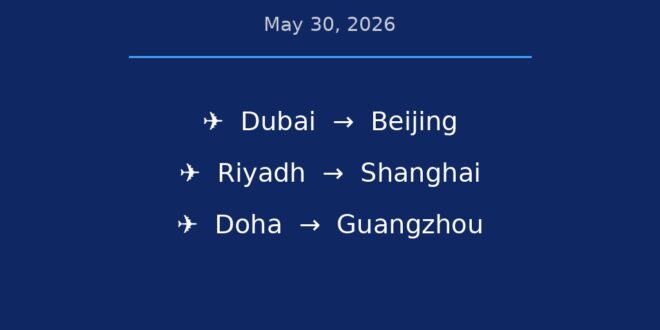
Airlines across the region have responded aggressively to rising demand. Qatar Airways is leading the expansion, increasing its Shanghai services from daily to 10 weekly flights between January and March 2026. The carrier now operates over 150 weekly flights to 13 Saudi cities, while Emirates and Etihad continue to expand their China networks.
- Qatar Airways: Shanghai flights increased to 10 weekly (Jan-Mar 2026)
- Over 150 weekly flights now connect Qatar to Saudi cities
- Emirates, Etihad, and Saudia are all restoring and expanding China routes
- Airspace reopening across the region has stabilized travel corridors
Chinese Tourists Flock to the Gulf
Chinese outbound tourism has fully recovered, with the Middle East emerging as a major growth market. Saudi Arabia has seen its Chinese visitor numbers double between 2023 and 2024, reaching a record 140,000 tourists in 2024 alone. Chinese travelers are drawn by the region’s luxury positioning, cultural heritage, and competitive positioning under the Belt and Road Initiative.
- Chinese visitors to Saudi Arabia doubled between 2023 and 2024
- Record 140,000 Chinese tourists visited Saudi Arabia in 2024
- China accounts for 25% of global luxury sales — and Middle East markets are a prime shopping destination
- Chinese tourists spent over USD 255 billion globally on outbound travel in 2019
What This Means for Businesses
The tourism boom is creating a ripple effect across multiple sectors. Hotels, duty-free retailers, travel agencies, and cultural attractions are all positioned to benefit from the growing two-way flow of travelers. For Middle Eastern businesses, the key is to understand Chinese traveler preferences: seamless digital payment options, Mandarin-speaking staff, and culturally tailored experiences.
- Duty-free retail in China is expanding to attract high-net-worth Middle Eastern tourists
- Hotels in Dubai and Riyadh are adding Mandarin services and Chinese cuisine
- Digital payment systems (WeChat Pay, Alipay) are being integrated across GCC destinations
Sources
- APCO Worldwide — China-Middle East Tourism Cooperation Report
- China Daily — Chinese tourists return to global markets
- Nomad Lawyer — China Tourism Travel 2026: Visa-Free Entry
- Future Market Insights — China Outbound Travel Market
- Connecting Travel — 16 new flights launching from GCC in 2026