


 CNINME.COM China-Middle East trade intelligence, sourcing, market entry and business culture.

Related Articles

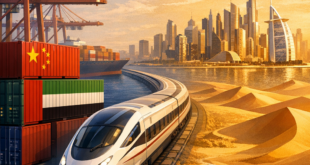

Two Decades in the Making, One Summit Could Seal It
After more than 20 years of on-and-off negotiations, the China–Gulf Cooperation Council Free Trade Agreement is closer to reality than ever before. With the Second China-Arab States Summit and the China-GCC Summit both scheduled for 2026, trade officials from Beijing to Riyadh are racing to finalize what could become one of the world’s most consequential trade deals.
The stakes are enormous. China-GCC trade reached $257 billion in 2024 — a 14.2% year-on-year increase — and shows no signs of slowing. For context, that figure is more than two and a half times the total trade volume between the United States and the entire Middle East-North Africa region.
Why 2026 Is Different
Several converging factors have created unprecedented momentum:
- Diplomatic acceleration: Chinese Foreign Minister Wang Yi’s December 2025 visit to the UAE produced a joint commitment to “promote the early conclusion of negotiations.” GCC Secretary General Jasem Albudaiwi met with China’s Vice Minister of Commerce in Doha in October 2026 to review progress.
- Summit deadlines: Both the China-Arab States Summit and the China-GCC Summit are expected to serve as platforms for signing or announcing substantial progress.
- Economic alignment: Saudi Vision 2030, UAE’s “We the UAE 2031,” and Qatar’s National Vision 2030 all require massive infrastructure, technology, and manufacturing investment — precisely what China’s Belt and Road Initiative delivers.
The Trade Landscape by Numbers
The economic interdependence between China and the Gulf is already deep and multifaceted:
- China’s crude oil imports: Approximately 11 million barrels per day, with over half sourced from the Middle East
- UAE-China non-oil trade: $111.5 billion in 2025, up 24.5% annually, with a bilateral target of $300 billion by 2030
- GCC sovereign wealth funds: More than $120 billion invested in China as of May 2026
- LNG contracts: ADNOC signed three term contracts with Chinese buyers in 2025 alone, including a deal with CNOOC for 500,000 metric tons annually starting 2026
- China-UAE trade (Jan-Sep 2026): $58.9 billion in goods trade, with China exporting $41.1 billion and importing $17.8 billion
What’s Holding Up the Deal?
Despite the optimism, significant obstacles remain:
- Saudi industrial policy concerns: Riyadh fears that a flood of cheaper Chinese imports could undermine its Vision 2030 goal of localizing higher-value manufacturing
- Standards and services: The FTA is not just about tariffs — it involves technical standards, services market access, investment protections, and digital trade rules
- Geopolitical balancing: Gulf states are carefully navigating their relationships with both China and the United States, avoiding exclusive alignment with either power
What a Deal Would Mean for Businesses
If concluded, the China-GCC FTA would create one of the world’s largest free trade zones, covering a combined population of over 600 million people. Key implications include:
- Tariff elimination on the majority of goods traded between China and GCC states
- Streamlined customs procedures reducing clearance times at ports like Jebel Ali and Khalifa
- Enhanced investment protections encouraging cross-border direct investment
- New sectors opening up: clean energy, electric vehicles, advanced manufacturing, digital services, and sustainable agriculture
- Supply chain reconfiguration: Gulf states positioning as re-export hubs for Chinese goods into Africa and Europe
The Road Ahead
Whether the FTA is signed at the 2026 summits or continues its two-decade marathon, the trajectory is clear: China-GCC economic integration is deepening regardless. Bilateral trade has grown from $87 billion in 2010 to $257 billion in 2024 — a nearly threefold increase. Gulf sovereign wealth funds are among the most active investors in Chinese markets, and Chinese firms like BYD and Nio are establishing manufacturing presences in the UAE.
The question is no longer *if* the economic relationship will transform, but *how fast* — and whether formal trade architecture can keep pace with the reality on the ground.
Sources:
- China Daily: “China tops trade partners in Gulf region” (Nov 2025)
- The National: “UAE and China sign initial pact to boost investment flows” (Apr 2026)
- GCC Secretariat: Meeting between H.E. GCC SG and Chinese Vice Minister of Commerce (Oct 2026)
- UECN: “China-GCC Free Trade Agreement: Breaking the Two-Decade Impasse in 2026”
- ChinaData: China-UAE Trade Statistics (2026)
- Middle East Council on Global Affairs: “China-GCC Relations in an Emerging Multipolar Order”
- Reuters: “China urges Gulf nations to seal free trade agreement” (Dec 2025)
- MEPEI: “The Current Relationship between PRC and GCC Monarchies” (2026)
